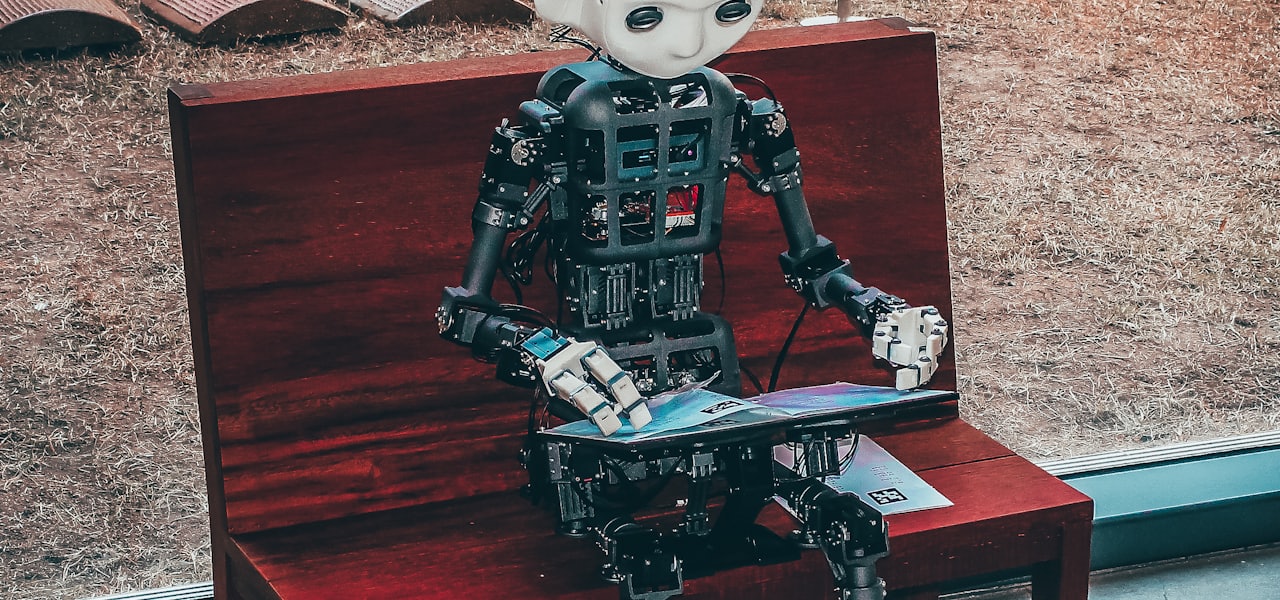
Speech segmentation is the process of identifying the boundaries between words, syllables, or phonemes in spoken natural languages. The term applies both to the mental processes used by humans, and to artificial processes of natural language processing. In the field of automatic pronunciation assessment, the process of segmenting an utterance against expected word(s) is called forced alignment. Speech segmentation is a subfield of general speech perception and an important subproblem of the technologically focused field of speech recognition, and cannot be adequately solved in isolation. As in most natural language processing problems, one must take into account context, grammar, and semantics, and even so the result is often a probabilistic division (statistically based on likelihood) rather than a categorical one. Though it seems that coarticulation—a phenomenon which may happen between adjacent words just as easily as within a single word—presents the main challenge in speech segmentation across languages, some other problems and strategies employed in solving those problems can be seen in the following sections. This problem overlaps to some extent with the problem of text segmentation that occurs in some languages which are traditionally written without inter-word spaces, like Chinese and Japanese, compared to writing systems which indicate speech segmentation between words by a word divider, such as the space. However, even for those languages, text segmentation is often much easier than speech segmentation, because the written language usually has little interference between adjacent words, and often contains additional clues not present in speech (such as the use of Chinese characters for word stems in Japanese). == Lexical recognition == In natural languages, the meaning of a complex spoken sentence can be understood by decomposing it into smaller lexical segments (roughly, the words of the language), associating a meaning to each segment, and combining those meanings according to the grammar rules of the language. Though lexical recognition is not thought to be used by infants in their first year, due to their highly limited vocabularies, it is one of the major processes involved in speech segmentation for adults. Three main models of lexical recognition exist in current research: first, whole-word access, which argues that words have a whole-word representation in the lexicon; second, decomposition, which argues that morphologically complex words are broken down into their morphemes (roots, stems, inflections, etc.) and then interpreted and; third, the view that whole-word and decomposition models are both used, but that the whole-word model provides some computational advantages and is therefore dominant in lexical recognition. To give an example, in a whole-word model, the word "cats" might be stored and searched for by letter, first "c", then "ca", "cat", and finally "cats". The same word, in a decompositional model, would likely be stored under the root word "cat" and could be searched for after removing the "s" suffix. "Falling", similarly, would be stored as "fall" and suffixed with the "ing" inflection. Though proponents of the decompositional model recognize that a morpheme-by-morpheme analysis may require significantly more computation, they argue that the unpacking of morphological information is necessary for other processes (such as syntactic structure) which may occur parallel to lexical searches. As a whole, research into systems of human lexical recognition is limited due to little experimental evidence that fully discriminates between the three main models. In any case, lexical recognition likely contributes significantly to speech segmentation through the contextual clues it provides, given that it is a heavily probabilistic system—based on the statistical likelihood of certain words or constituents occurring together. For example, one can imagine a situation where a person might say "I bought my dog at a ____ shop" and the missing word's vowel is pronounced as in "net", "sweat", or "pet". While the probability of "netshop" is extremely low, since "netshop" isn't currently a compound or phrase in English, and "sweatshop" also seems contextually improbable, "pet shop" is a good fit because it is a common phrase and is also related to the word "dog". Moreover, an utterance can have different meanings depending on how it is split into words. A popular example, often quoted in the field, is the phrase "How to wreck a nice beach", which sounds very similar to "How to recognize speech". As this example shows, proper lexical segmentation depends on context and semantics which draws on the whole of human knowledge and experience, and would thus require advanced pattern recognition and artificial intelligence technologies to be implemented on a computer. Lexical recognition is of particular value in the field of computer speech recognition, since the ability to build and search a network of semantically connected ideas would greatly increase the effectiveness of speech-recognition software. Statistical models can be used to segment and align recorded speech to words or phones. Applications include automatic lip-synch timing for cartoon animation, follow-the-bouncing-ball video sub-titling, and linguistic research. Automatic segmentation and alignment software is commercially available. == Phonotactic cues == For most spoken languages, the boundaries between lexical units are difficult to identify; phonotactics are one answer to this issue. One might expect that the inter-word spaces used by many written languages like English or Spanish would correspond to pauses in their spoken version, but that is true only in very slow speech, when the speaker deliberately inserts those pauses. In normal speech, one typically finds many consecutive words being said with no pauses between them, and often the final sounds of one word blend smoothly or fuse with the initial sounds of the next word. The notion that speech is produced like writing, as a sequence of distinct vowels and consonants, may be a relic of alphabetic heritage for some language communities. In fact, the way vowels are produced depends on the surrounding consonants just as consonants are affected by surrounding vowels; this is called coarticulation. For example, in the word "kit", the [k] is farther forward than when we say 'caught'. But also, the vowel in "kick" is phonetically different from the vowel in "kit", though we normally do not hear this. In addition, there are language-specific changes which occur in casual speech which makes it quite different from spelling. For example, in English, the phrase "hit you" could often be more appropriately spelled "hitcha". From a decompositional perspective, in many cases, phonotactics play a part in letting speakers know where to draw word boundaries. In English, the word "strawberry" is perceived by speakers as consisting (phonetically) of two parts: "straw" and "berry". Other interpretations such as "stra" and "wberry" are inhibited by English phonotactics, which does not allow the cluster "wb" word-initially. Other such examples are "day/dream" and "mile/stone" which are unlikely to be interpreted as "da/ydream" or "mil/estone" due to the phonotactic probability or improbability of certain clusters. The sentence "Five women left", which could be phonetically transcribed as [faɪvwɪmɘnlɛft], is marked since neither /vw/ in /faɪvwɪmɘn/ nor /nl/ in /wɪmɘnlɛft/ are allowed as syllable onsets or codas in English phonotactics. These phonotactic cues often allow speakers to easily distinguish the boundaries in words. Vowel harmony in languages like Finnish can also serve to provide phonotactic cues. While the system does not allow front vowels and back vowels to exist together within one morpheme, compounds allow two morphemes to maintain their own vowel harmony while coexisting in a word. Therefore, in compounds such as "selkä/ongelma" ('back problem') where vowel harmony is distinct between two constituents in a compound, the boundary will be wherever the switch in harmony takes place—between the "ä" and the "ö" in this case. Still, there are instances where phonotactics may not aid in segmentation. Words with unclear clusters or uncontrasted vowel harmony as in "opinto/uudistus" ('student reform') do not offer phonotactic clues as to how they are segmented. From the perspective of the whole-word model, however, these words are thought be stored as full words, so the constituent parts would not necessarily be relevant to lexical recognition. == In infants and non-natives == Infants are one major focus of research in speech segmentation. Since infants have not yet acquired a lexicon capable of providing extensive contextual clues or probability-based word searches within their first year, as mentioned above, they must often rely primarily upon phonotactic and rhythmic cues (with prosody being the dominant cue), all
Logical Machine Corporation
Logical Machine Corporation (LOMAC) was an American computer company active from the mid-1970s to the 1980s and based in the San Francisco Bay Area. It was founded as John Peers and Company by the British entrepreneur John Peers in 1974. LOMAC developed the ADAM, a minicomputer which ran a specialized compiler for the company's natural English programming language. Throughout the late 1970s, the company acquired several technology firms, including Byte, Inc., the owner of the Byte Shop retail chain. Despite its unique approach to computing and earning $5 million in revenue in 1977, LOMAC struggled as the industry began to standardize around the IBM Personal Computer (IBM PC). Following Peers's departure in 1980, the company rebranded as Logical Business Machines, Inc. (LBM, or simply Logical), and attempted to pivot toward IBM PC–compatible hardware. However, financial difficulties led to the company filing for Chapter 11 bankruptcy in 1984. After emerging from bankruptcy in 1985 with new investment, Logical ceased hardware manufacturing to focus exclusively on software development and value-added reselling. == History == John Peers (born 1942) founded Logical Machine Corporation as John Peers and Company in September 1974. The company originally occupied a 4,500-square-foot office in Burlingame, California. The company was Peers' fourth; he had recently sold off Allied Business Systems of London to Trafalgar House in 1974. Peers sought to set up manufacturing in an agricultural zone in Ukiah, California. Following a delay, caused in part by concerned residents, a 30,000-square-foot plant was raised in Burke Hill, three miles south of Ukiah. The Ukiah plant was built to mass manufacture the company's ADAM minicomputer. The ADAM computer ran a specialized compiler for the company's natural English programming language; that is to say, the programming language attempted to closely emulate English syntax. Prototypes of the ADAM were built in May 1974, based on specifications devised in October 1973. Peers had yet to patent the technology as of June 1975. The ADAM's central processing unit was bolted onto an 7-by-6-foot L-shaped desk, on which rested its terminal. Twenty units of the ADAM were installed between April 1975 and February 1976, out of a backlog of orders for 3,500 from 500 clients, manufactured out of the company's Burlingame headquarters. It cost US$40,000. A controversial print advertisement featuring a naked woman seated at an ADAM terminal—as a pastiche of Adam and Eve—was recalled in early 1976 as a result of outcry from the National Organization for Women. The company changed its name to Logical Machine Corporation (LOMAC) in October 1976 and moved its headquarters to a 26,000-square-foot building in Sunnyvale, California, in anticipation of a ramping up of orders for the ADAM. The company originally occupied half of the building; they later purchased the other half from the tenant in July 1977 to double its manufacturing output. For fiscal year 1977, the company earned $5 million in revenue. In December 1977, LOMAC acquired Byte, Inc.—the proprietor of The Byte Shop, the first computer retail chain—from Paul Terrell and Boyd Wilson for an unspecified amount. The Byte Shop had 65 locations in the San Francisco Bay Area in 1978; it catered mainly to hobbyists with low cost microcomputer kits, in contrast to the high cost of LOMAC's ADAM. By July 1978, however, LOMAC were able to reduce the price of the ADAM down to $15,000. The company by that point had shipped their 50th ADAM and expanded to 14 countries. Also in 1978, LOMAC acquired Mass Memory—a high-tech optical storage company based in Phoenix, Arizona, whose products had storage capacities on the order gigabytes and terabytes—and Centigram, makers of the Mike—a computer with speech recognition. Later that year, the company introduced Tina, a low-cost version of the ADAM. LOMAC suffered losses that year and appointed Jerry Brandt to the board of directions, naming him chief operating officer, in August 1978. Brandt had Logical absorb Mass Memory and Centigram into the parent operations, shutting down their respective plants in the process, converted 10 Byte Shops to franchises and opened 25 more franchised Byte locations, and stopped direct sales of LOMAC's business computer products. By the beginning of 1979, LOMAC was profitable once more, and Brandt was let go from LOMAC. Peers left LOMAC in 1980, following a slump in the company's sales. He became an executive director of the United States Robotics Society, a consortium for industrial automation companies, that year. Following Peers' departure, LOMAC changed its name to Logical Business Machines, adopting the name of its European subsidiary. In 1983, the company announced a 16-bit clone of the IBM PC, called the Logical L-XT, which featured a 10-MB hard drive, 320-KB floppy drive and 192 KB of RAM, and a real-time clock, and came shipped with various software (including MS-DOS, a word processor, and a spreadsheet application) and an amber CRT monitor. The following year, the company introduced L-NET, a local area network system based on the L-XT that could link up to 64 computers. L-NET came shipped with a natural programming language, Diplomat—a descendant of the programming language used on the ADAM. In June 1983, Logical sued Coleco Industries over trademark infringement with the latter's to-be-released Adam microcomputer. Logical cited confusion from their existing ADAM customer base caused by the announcement of the Coleco Adam as the basis for the suit. Coleco challenged Logical in the press, writing that Logical's rights to the Adam trademark for use in computers had lapsed earlier in the year. The two settled out of court, with Coleco agreeing to license the Adam name from Logical in exchange for unlimited rights to the Adam trademark. Logical halted development of the L-XT when they filed for Chapter 11 bankruptcy in July 1984. The company had been $4 million in debt. They emerged from bankruptcy in September 1985, after being infused with $2 million from Carat Ltd. The latter immediately received a little less than 50 percent ownership in Logical—this stake set to grow to over 50 percent over the next six months. As part of the terms of exiting bankruptcy, Logical stopped manufacturing hardware and strictly became a software development company and value-added reseller of computer systems.
Push technology
Push technology, also known as server push, is a communication method where the communication is initiated by a server rather than a client. This approach is different from the "pull" method where the communication is initiated by a client. In push technology, clients can express their preferences for certain types of information or data, typically through a process known as the publish–subscribe model. In this model, a client "subscribes" to specific information channels hosted by a server. When new content becomes available on these channels, the server automatically sends, or "pushes," this information to the subscribed client. Under certain conditions, such as restrictive security policies that block incoming HTTP requests, push technology is sometimes simulated using a technique called polling. In these cases, the client periodically checks with the server to see if new information is available, rather than receiving automatic updates. == General use == Synchronous conferencing and instant messaging are examples of push services. Chat messages and sometimes files are pushed to the user as soon as they are received by the messaging service. Both decentralized peer-to-peer programs (such as WASTE) and centralized programs (such as IRC or XMPP) allow pushing files, which means the sender initiates the data transfer rather than the recipient. Email may also be a push system: SMTP is a push protocol (see Push e-mail). However, the last step—from mail server to desktop computer—typically uses a pull protocol like POP3 or IMAP. Modern e-mail clients make this step seem instantaneous by repeatedly polling the mail server, frequently checking it for new mail. The IMAP protocol includes the IDLE command, which allows the server to tell the client when new messages arrive. The original BlackBerry was the first popular example of push-email in a wireless context. Another example is the PointCast Network, which was widely covered in the 1990s. It delivered news and stock market data as a screensaver. Both Netscape and Microsoft integrated push technology through the Channel Definition Format (CDF) into their software at the height of the browser wars, but it was never very popular. CDF faded away and was removed from the browsers of the time, replaced in the 2000s with RSS (a pull system.) Other uses of push-enabled web applications include software updates distribution ("push updates"), market data distribution (stock tickers), online chat/messaging systems (webchat), auctions, online betting and gaming, sport results, monitoring consoles, and sensor network monitoring. == Examples == === Web push === The Web push proposal of the Internet Engineering Task Force is a simple protocol using HTTP version 2 to deliver real-time events, such as incoming calls or messages, which can be delivered (or "pushed") in a timely fashion. The protocol consolidates all real-time events into a single session which ensures more efficient use of network and radio resources. A single service consolidates all events, distributing those events to applications as they arrive. This requires just one session, avoiding duplicated overhead costs. Web Notifications are part of the W3C standard and define an API for end-user notifications. A notification allows alerting the user of an event, such as the delivery of an email, outside the context of a web page. As part of this standard, Push API is fully implemented in Chrome, Firefox, and Edge, and partially implemented in Safari as of February 2023. === HTTP server push === HTTP server push (also known as HTTP streaming) is a mechanism for sending unsolicited (asynchronous) data from a web server to a web browser. HTTP server push can be achieved through any of several mechanisms. As a part of HTML5 the Web Socket API allows a web server and client to communicate over a full-duplex TCP connection. Generally, the web server does not terminate a connection after response data has been served to a client. The web server leaves the connection open so that if an event occurs (for example, a change in internal data which needs to be reported to one or multiple clients), it can be sent out immediately; otherwise, the event would have to be queued until the client's next request is received. Most web servers offer this functionality via CGI (e.g., Non-Parsed Headers scripts on Apache HTTP Server). The underlying mechanism for this approach is chunked transfer encoding. Another mechanism is related to a special MIME type called multipart/x-mixed-replace, which was introduced by Netscape in 1995. Web browsers interpret this as a document that changes whenever the server pushes a new version to the client. It is still supported by Firefox, Opera, and Safari today, but it is ignored by Internet Explorer and is only partially supported by Chrome. It can be applied to HTML documents, and also for streaming images in webcam applications. The WHATWG Web Applications 1.0 proposal includes a mechanism to push content to the client. On September 1, 2006, the Opera web browser implemented this new experimental system in a feature called "Server-Sent Events". It is now part of the HTML5 standard. === Pushlet === In this technique, the server takes advantage of persistent HTTP connections, leaving the response perpetually "open" (i.e., the server never terminates the response), effectively fooling the browser to remain in "loading" mode after the initial page load could be considered complete. The server then periodically sends snippets of JavaScript to update the content of the page, thereby achieving push capability. By using this technique, the client doesn't need Java applets or other plug-ins in order to keep an open connection to the server; the client is automatically notified about new events, pushed by the server. One serious drawback to this method, however, is the lack of control the server has over the browser timing out; a page refresh is always necessary if a timeout occurs on the browser end. === Long polling === Long polling is itself not a true push; long polling is a variation of the traditional polling technique, but it allows emulating a push mechanism under circumstances where a real push is not possible, such as sites with security policies that require rejection of incoming HTTP requests. With long polling, the client requests to get more information from the server exactly as in normal polling, but with the expectation that the server may not respond immediately. If the server has no new information for the client when the poll is received, then instead of sending an empty response, the server holds the request open and waits for response information to become available. Once it does have new information, the server immediately sends an HTTP response to the client, completing the open HTTP request. Upon receipt of the server response, the client often immediately issues another server request. In this way the usual response latency (the time between when the information first becomes available and the next client request) otherwise associated with polling clients is eliminated. For example, BOSH is a popular, long-lived HTTP technique used as a long-polling alternative to a continuous TCP connection when such a connection is difficult or impossible to employ directly (e.g., in a web browser); it is also an underlying technology in the XMPP, which Apple uses for its iCloud push support. === Flash XML Socket relays === This technique, used by chat applications, makes use of the XML Socket object in a single-pixel Adobe Flash movie. Under the control of JavaScript, the client establishes a TCP connection to a unidirectional relay on the server. The relay server does not read anything from this socket; instead, it immediately sends the client a unique identifier. Next, the client makes an HTTP request to the web server, including this identifier with it. The web application can then push messages addressed to the client to a local interface of the relay server, which relays them over the Flash socket. The advantage of this approach is that it appreciates the natural read-write asymmetry that is typical of many web applications, including chat, and as a consequence it offers high efficiency. Since it does not accept data on outgoing sockets, the relay server does not need to poll outgoing TCP connections at all, making it possible to hold open tens of thousands of concurrent connections. In this model, the limit to scale is the TCP stack of the underlying server operating system. === Reliable Group Data Delivery (RGDD) === In services such as cloud computing, to increase reliability and availability of data, it is usually pushed (replicated) to several machines. For example, the Hadoop Distributed File System (HDFS) makes 2 extra copies of any object stored. RGDD focuses on efficiently casting an object from one location to many while saving bandwidth by sending minimal number of copies (only one in the best case) of
Full30
Full30 was an American online video-sharing platform primarily dedicated to firearms and shooting sports-related content. The service was established in 2014 by Tim Harmsen and Mark Hammonds as a result of YouTube's increasing restrictions on gun-related videos. == History == After the 2018 Parkland high school shooting, many companies attempted to distance themselves from any association with the firearms industry. As a result, YouTube began demonetizing and sometimes outright deleting firearms-related videos, and in one case, popular YouTube poster Hickok45's channel was completely deleted but later restored. In response, Harmsen, who operates the Military Arms Channel on YouTube, decided to create his own video-hosting website to allow himself and other firearms content creators a platform free from such restrictions; he named the website Full30 — a reference to the popular 30-round STANAG magazine. In July 2020, site representatives announced the site had new ownership. By the end of 2022, the site began to be redirected to a series of other websites. By 2025, it was largely deactivated with the front page replaced by a form to be filled out to receive "updates", with no other explanation. == Contributors == Hickok45 Military Arms Channel Forgotten Weapons Bavarian Shooter Liberty Doll CloverTac
Fansly
Fansly is a subscription-based social media platform that allows content creators to monetize exclusive content, including photos, videos, live streams, and direct messages. Operated by Select Media LLC, the platform is headquartered in Baltimore, Maryland. While the platform hosts a variety of content genres, it is primarily known for adult content and is frequently compared to OnlyFans. == History == Fansly was launched in 2020 by Micheal Etelis under Select Media LLC, which was incorporated in February 2020. The platform also operates through CY Media LTD, registered in Kamares, Cyprus, established in May 2021. The company has remained privately held with no disclosed external funding rounds or official valuation, operating as a bootstrapped entity. Based on Fansly's social media presence, which was created in November 2020, the platform did not begin gaining traction until early 2021 when creators started to become concerned about potential content policy changes at OnlyFans. In August 2021, OnlyFans announced it would ban sexually explicit content effective October 2021, citing pressure from banks involved in its payment processing. Although OnlyFans reversed the decision six days later, the announcement triggered a massive influx of users to Fansly; the platform received nearly 4,000 new creator applications in a single hour, causing its servers to crash from the surge in traffic. By August 21, 2021, Fansly had reached 2.1 million users. == Features and business model == Fansly operates as a B2C marketplace, taking a 20% commission on all transactions conducted on the platform, with creators retaining the remaining 80%. This commission rate is the same as that charged by its main competitor, OnlyFans. A distinguishing feature of Fansly is its tiered subscription model, which allows creators to set multiple subscription levels at different price points, each offering different perks such as exclusive content, chat access, or custom requests. By contrast, OnlyFans historically relied on a single-tier subscription model. Revenue streams on the platform include recurring subscriptions, one-time pay-per-view content purchases, tips, paid messaging, and live-streaming fees. The platform also features an algorithmic "For You" feed that helps users discover new creators, addressing a limitation of competitors that lack internal content promotion mechanisms. Additional features include content watermarking, geolocation blocking to control where content is visible, two-factor authentication, community polls, 24-hour stories, and social media integration with platforms such as Twitter and Twitch. Payouts are processed within one to two business days and support multiple methods, including bank transfers, Skrill, Paxum, and cryptocurrency. In December 2025, Fansly expanded its live-streaming capabilities, introducing ticketed access, private list gating, configurable chat permissions, stream goals, and interactive device integration. == Controversies == === OnlyFans anti-competitive allegations === In August 2022, a series of lawsuits were filed in the United States alleging that OnlyFans had bribed employees of Meta Platforms to place Instagram accounts of creators who also sold content on competitor platforms, including Fansly, onto a terrorist blacklist. The lawsuits alleged that adult performers had traffic driven away from their Instagram accounts after being falsely tagged as terror-related. OnlyFans denied awareness of such activity. The plaintiffs withdrew the bribery claim in July 2023, and the case was dismissed in August 2023. === Privacy class action === In June 2025, Select Media LLC (operating as Fansly) was the subject of a digital privacy class action lawsuit filed in Massachusetts District Court. The lawsuit alleged that the platform secretly collected and shared users' sensitive viewing data with Google and other third parties without consent. The case was brought on behalf of an estimated class of over 10,000 users across multiple states.
Czekanowski distance
The Czekanowski distance (sometimes shortened as CZD) is a per-pixel quality metric that estimates quality or similarity by measuring differences between pixels. Because it compares vectors with strictly non-negative elements, it is often used to compare colored images, as color values cannot be negative. This different approach has a better correlation with subjective quality assessment than PSNR. == Definition == Androutsos et al. give the Czekanowski coefficient as follows: d z ( i , j ) = 1 − 2 ∑ k = 1 p min ( x i k , x j k ) ∑ k = 1 p ( x i k + x j k ) {\displaystyle d_{z}(i,j)=1-{\frac {2\sum _{k=1}^{p}{\text{min}}(x_{ik},\ x_{jk})}{\sum _{k=1}^{p}(x_{ik}+x_{jk})}}} Where a pixel x i {\displaystyle x_{i}} is being compared to a pixel x j {\displaystyle x_{j}} on the k-th band of color – usually one for each of red, green and blue. For a pixel matrix of size M × N {\displaystyle M\times N} , the Czekanowski coefficient can be used in an arithmetic mean spanning all pixels to calculate the Czekanowski distance as follows: 1 M N ∑ i = 0 M − 1 ∑ j = 0 N − 1 ( 1 − 2 ∑ k = 1 3 min ( A k ( i , j ) , B k ( i , j ) ) ∑ k = 1 3 ( A k ( i , j ) + B k ( i , j ) ) ) {\displaystyle {\frac {1}{MN}}\sum _{i=0}^{M-1}\sum _{j=0}^{N-1}{\begin{pmatrix}1-{\frac {2\sum _{k=1}^{3}{\text{min}}(A_{k}(i,j),\ B_{k}(i,j))}{\sum _{k=1}^{3}(A_{k}(i,j)+B_{k}(i,j))}}\end{pmatrix}}} Where A k ( i , j ) {\displaystyle A_{k}(i,j)} is the (i, j)-th pixel of the k-th band of a color image and, similarly, B k ( i , j ) {\displaystyle B_{k}(i,j)} is the pixel that it is being compared to. == Uses == In the context of image forensics – for example, detecting if an image has been manipulated –, Rocha et al. report the Czekanowski distance is a popular choice for Color Filter Array (CFA) identification.
Military communications
Military communications or military signals involve all aspects of communications, or conveyance of information, by armed forces. Examples from Jane's Military Communications include text, audio, facsimile, tactical ground-based communications, naval signalling, terrestrial microwave, tropospheric scatter, satellite communications systems and equipment, surveillance and signal analysis, security, direction finding and jamming. The most urgent purposes are to communicate information to commanders and orders from them. Military communications span from pre-history to the present. The earliest military communications were delivered by runners. Later, communications progressed to visual signals. For example, Naval ships would use flag signaling to communicate from ship to ship. These flags are a uniform set of easily identifiable nautical codes that would convey visual messages and codes between ships and from ship to shore. Then militaries discovered methods to use audible signaling to communicate with each other. This way of communicating was possible because of telegraphs. They are an electronic device that is used by a sender and when the sender presses on the telegraph key, they interrupt the current creating an audible pulse that is heard at the receiving station. The receiver then decodes the pulses to decode the messages. Since then, military communication has evolved and advanced much further. Today, there are many perspectives used to examine how troops around the world communicate. Anthony King states how Military sociologists have attempted to explain how military institutions develop and maintain high levels of social cohesion. == History == In past centuries communicating a message usually required someone to go to the destination, bringing the message. Thus, the term communication often implied the ability to transport people and supplies. A place under siege was one that lost communication in both senses. The association between transport and messaging declined in recent centuries. The first military communications involved the use of runners or the sending and receiving of simple signals (sometimes encoded to be unrecognizable). The first distinctive uses of military communications were called semaphore. Modern units specializing in these tactics are usually designated as signal corps. The Roman system of military communication (cursus publicus or cursus vehicularis) is an early example of this. Later, the terms signals and signaller became words referring to a highly-distinct military occupation dealing with general communications methods (similar to those in civil use) rather than with weapons. Present-day military forces of an informational society conduct intense and complicated communicating activities on a daily basis, using modern telecommunications and computing methods. Only a small portion of these activities are directly related to combat actions. Modern concepts of network-centric warfare (NCW) rely on network-oriented methods of communications and control to make existing forces more effective. == Military communications equipment == Drums, horns, flags, and riders on horseback were some of the early methods the military used to send messages over distances. The advent of distinctive signals led to the formation of the signal corps, a group specialized in the tactics of military communications. The signal corps evolved into a distinctive occupation where the signaller became a highly technical job dealing with all available communications methods including civil ones. In the middle 20th century radio equipment came to dominate the field. Many modern pieces of military communications equipment are built to both encrypt and decode transmissions and survive rough treatment in hostile climates. They use different frequencies to send signals to other radio stations to communicate. Radios have played a major role in military communication. Since they are capable of sending radio waves to transmit voice signals over long distances. This can be helpful for communication on the battlefield since it is a good way to send messages undetected over long distances. Radios are also very reliable because even in harsh weather conditions they are still able to help communicate among the soldiers. Militaries still use radios and continue to improve the technology because of their durability and reliability for military communication. Spelling alphabets such as the NATO phonetic alphabet are used to aid radio communications by reducing ambiguity between letters. Military communications – or "comms" – are activities, equipment, techniques, and tactics used by the military in some of the most hostile areas of the earth and in challenging environments such as battlefields, on land (compare radio in a box), underwater and also in air. Military comms include command, control and communications and intelligence and were known as the C3I model before computers were fully integrated. The U.S. Army expanded the model to C4I when it recognized the vital role played by automated computer equipment to send and receive large, bulky amounts of data. In the modern world, most nations attempt to minimize the risk of war caused by miscommunication or inadequate communication. As a result, military communication is intense and complicated and often motivates the development of advanced technology for remote systems such as satellites. Satellites have been improving and are being used more and more for communication. They are being made to have higher transmission capacity to help with their communication abilities. The military is upgrading satellites to be immune to interference during combat operations. This advancement will establish stable, high-quality information highways for long distance communication. Aircraft are also beneficial for communication, both crewed and uncrewed, as well as computers. Computers and their varied applications have revolutionized military comms. Although military communication is designed for warfare, it also supports intelligence-gathering and communication between adversaries, and thus sometimes prevents war. The six categories of military comms are: alert measurement systems cryptography military radio systems command and control signal corps network-centric warfare The alert measurement systems are various states of alertness or readiness for the armed forces used around the world during a state of war, act of terrorism or a military attack against a state. They are known by different acronyms, such as DEFCON, or defense readiness condition, used by the U.S. Armed Forces. Cryptography is the study of methods of converting messages to a form unreadable except to one who knows how to decrypt them. This ancient military comms art gained new importance with the rise of radio systems whose signals traveled far and were easily intercepted. Cryptographic software is also widely used in civilian commerce. == Commercial refile == In United States military communications systems, commercial refile refers to sending a military message via a commercial communications network. The message may come from a military network, such as a tape relay network, a point-to-point telegraph network, a radio-telegraph network, or the Defense Switched Network. Commercial refiling of a message will usually require a reformatting of the message, particularly the heading.